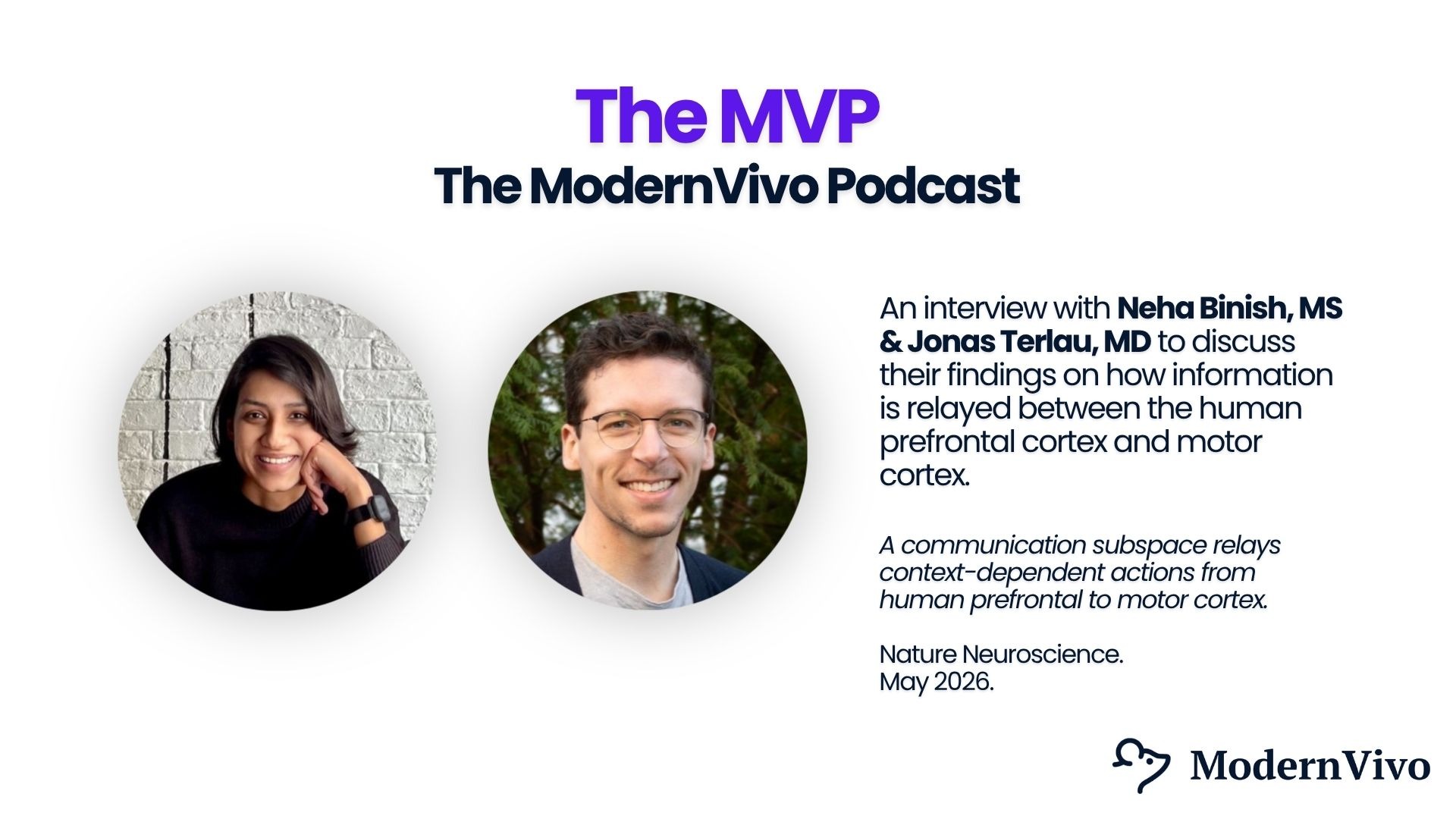
The MVP: The ModernVivo Podcast
Season 1, Episode 4 Show Notes: Neha Binish, MS & Jonas Terlau, MD
In this episode of The MVP — our first with two guests at once — I sat down with Neha Binish and Dr. Jonas Terlau, who work together in Randolph Helfrich's group at the Hertie Institute for Clinical Brain Research, University of Tübingen. We discussed their paper, "A Communication Subspace Relays Context-Dependent Actions from Human Prefrontal to Motor Cortex," published in Nature Neuroscience in May of 2026. In this blog post you can read more about their findings and scientific journeys. A PDF of the publication is available here to read and download. You can connect with Neha and Jonas on LinkedIn if you'd like to discuss their work further.
You can listen or watch this episode on Spotify, Apple Podcasts, or Youtube.
To inquire how to be a guest on the podcast, please contact andres@modernvivo.com.
Why the prefrontal cortex is such a puzzle.
The prefrontal cortex (PFC) has expanded dramatically over the course of primate evolution — and researchers still aren't entirely sure why. What's clear is that it underlies a huge leap in the complexity of behavior that sets humans apart. Jonas offered two vivid ways to think about what the PFC does.
The first is sequential action. Something as ordinary as making a cup of coffee is actually a complex, temporally extended sequence — and you can drop a single step and still complete the rest coherently. That's evidence that you're not simply chaining one action to the next; you're holding an abstract representation of the whole plan in mind. Patients with lesions in the PFC struggle badly with exactly this kind of multi-step, self-monitoring behavior.
The second is context-dependent behavior. The same sensory event can call for opposite responses depending on context: if your phone rings during a meeting you ignore it, but at home you pick up. The PFC is what lets you hold that context and act accordingly. Probing that capacity is exactly what the paper's task was built to do.
The task, and a rare kind of recording.
Neha explained that the team works with a very specific and hard-to-come-by dataset: intracranial recordings from patients with drug-resistant epilepsy, who are admitted to the hospital for around two weeks with electrodes placed on the cortical surface to help clinicians locate the origin of their seizures. Electrode placement is entirely determined by medical need — the researchers have no say in it — but when a patient happens to have coverage over both the PFC and a motor area, that opens a window for this kind of study.
The paper drew on recordings from 12 such patients. Because these subdural grid recordings (electrocorticography, or ECoG) sit directly on the cortical surface, they offer excellent temporal resolution (unlike EEG or fMRI) and access to high-frequency activity ("high gamma," or HFA) thought to reflect underlying population activity. As Neha noted, what high gamma truly represents is still debated, but it's the best marker currently available.
The task itself was deliberately simple. Patients watched a continuous stream of flashed triangles and pressed a button whenever a downward-facing triangle (the target) appeared. In the predictive condition, a specific sequence of three triangles reliably signaled the target was coming next; in the random condition, the target appeared without warning. When people could anticipate the target, they responded significantly faster; when they couldn't, they were slower. That difference in reaction time became the behavioral anchor for everything that followed.
What a "communication subspace" actually is.
Modern recordings let the team capture activity from multiple brain regions simultaneously — something that wasn't possible when you could only record one region at a time. With PFC and primary motor cortex (M1) recorded together, they could ask a concrete question: which patterns of PFC activity are most predictive of what M1 is doing? Those shared, predictive patterns are the "subspace."
Jonas placed this in context. Because you can now record from many channels at once, you see that neural activity isn't independent — many sites do correlated things, and you can find low-dimensional patterns that capture that shared structure. The familiar tool for finding such patterns is principal component analysis (PCA), which extracts the directions of greatest variance. A communication subspace is related but meaningfully different: instead of maximizing variance within the PFC, it maximizes the part of PFC activity that is predictive of M1 activity at the same time (the team used a method called reduced-rank regression to find it). It's a purely data-driven, functional way to define the pathway by which the PFC guides behavior through M1.
The paper first established that PFC activity is genuinely higher-dimensional (more complex) than M1 activity, consistent with the idea that behaviorally relevant signals can get buried in the PFC's rich, multiplexed activity. That set up the key move: a small, low-dimensional subspace within the PFC could selectively capture the action-relevant information routed to M1.
What they found surprised them at first. The PFC doesn't obviously show the sharp motor "peak" you see in an M1 channel at the moment of a button press — but once you look at the subspace of those shared patterns, that motor-like structure is there. Their first instinct was skepticism: was this just a mathematical artifact of optimizing a model to fit the data? The test was behavior. Activity in the subspace peaked earlier in predictive contexts than in random ones, and the size of that timing difference tracked how much each person actually sped up (a strong correlation across participants). Crucially, the subspace was defined purely from neural activity, with no access to the behavioral labels — yet it predicted context-dependent action, on both a participant-by-participant and single-trial level, more strongly than either region alone.
I offered an analogy in the conversation: is the PFC essentially compressing information on its way to the motor cortex — sending only what's necessary and sufficient rather than dumping everything? Both guests thought that was close, with an important caveat. What the data show for certain is that this compressed, behavior-linked pattern exists within the PFC and is correlated with behavior. Claiming it drives the motor cortex goes a step too far, since M1 was used to help identify the patterns in the first place. As they put it: it's an appealing interpretation, but correlation is as far as the current evidence can go.
"It's really straightforward to not think about the brain in terms of isolated areas that do their little computations… but as an interconnected network. Inter-regional communication is definitely one of the major ways that the brain generates behavior."
Implications: from BCIs to a more connected view of the brain.
Jonas, who now works on brain-computer interfaces (BCIs), sees clear relevance ahead. Low-dimensional patterns of activity tend to be far more stable over time than raw firing patterns, which matters enormously for chronic BCIs, where you want stable performance without constant recalibration as brain activity shifts (a phenomenon known as representational drift). Communication subspaces are a newer idea and haven't yet made their way into applications, but Jonas argued the field needs to move toward a multimodal approach — integrating structural imaging of white-matter pathways with neurophysiological tools like this one — to better understand how regions actually talk to each other, rather than treating the brain as a set of isolated modules.
For Neha, the appeal is partly aesthetic and partly conceptual: the idea that correlated activity across neurons forms patterns that are genuinely meaningful for behavior, not just noise. As I said during the recording, it's a humbling reminder that just when we think we understand the brain, it turns out to be far more complex than we imagined.
What's next for these scientists?
Jonas is heading further down the BCI path. Neha is aiming for a postdoc and hopes to keep working in the same vein — the theory-focused side of neuroscience, making sense of the massive volumes of neural data now being recorded across species and relating it to meaningful outputs like motor control, with an eye toward robotics, BCIs, and prosthetics. Both see this as a fast-evolving field they're glad to be contributing to.
On working as a team, Neha offered advice worth passing along: surround yourself with people who challenge your views. Coming from a technical background, she was drawn to the data and the patterns within it; Jonas consistently pushed on what those patterns mean neurophysiologically. Those questions, she said, are what led her to the analyses that ultimately proved the effect was real. Jonas’ advice was simple and poignant, “Talk to each other.”
If you have questions about the paper, Neha and Jonas are happy to connect. Reach out to them on LinkedIn or send me an email.
ModernVivo designs best-in-class literature review software to help preclinical scientists identify insights from millions of peer-reviewed papers to design their in vivo studies faster.
Anyone can sign up and start using ModernVivo for free. Whether you're an academic, a biopharma scientist, or a contract research organization, our tool can help you save countless hours on manual literature review, without sacrificing scientific rigor.
To learn more about how ModernVivo works, check out these demos. Reach out to andres@modernvivo.com if you'd like to discuss how we can support your research needs.