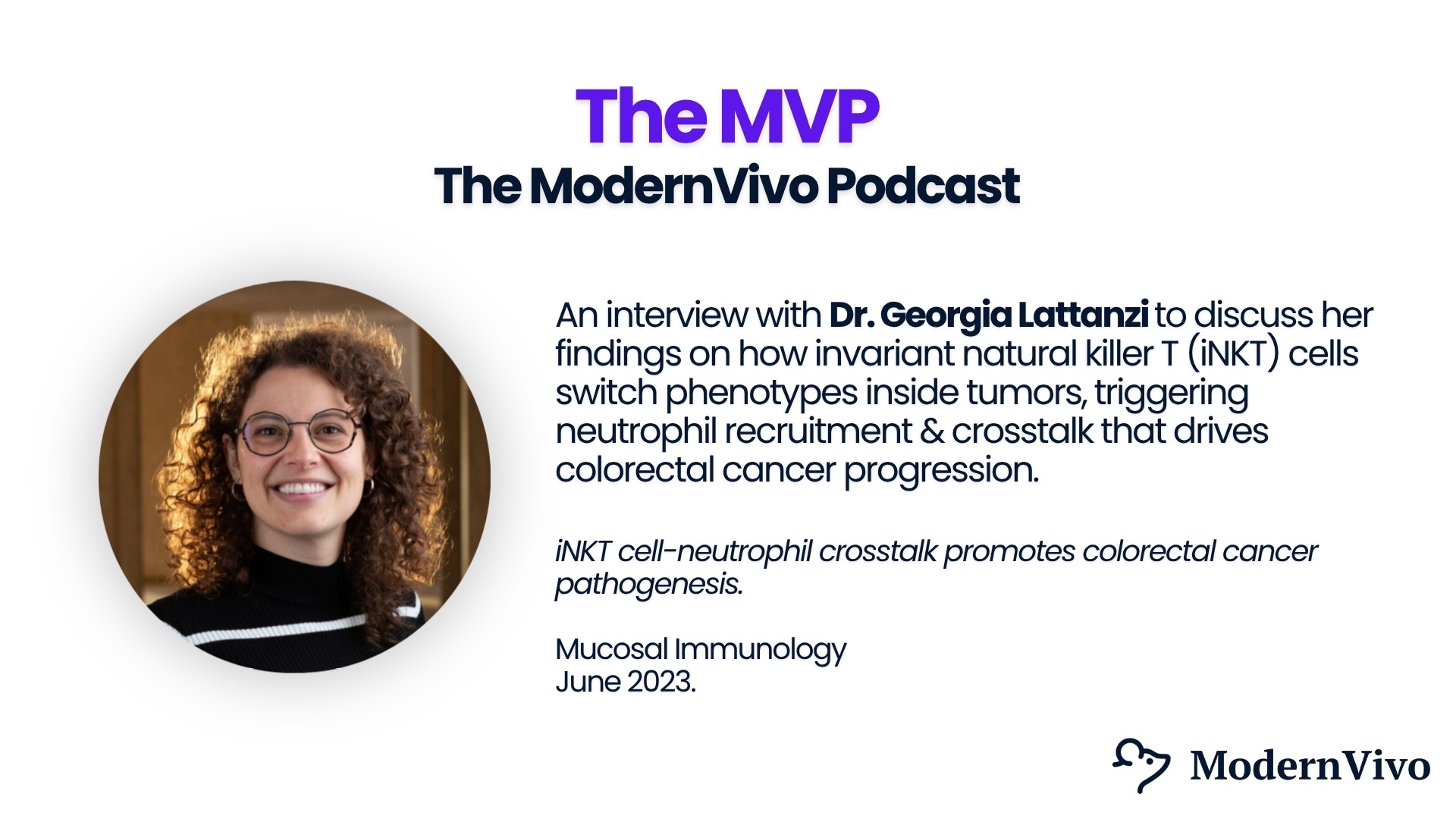
Season 1, Episode 6 Show Notes: Georgia Lattanzi, PhD
In this episode of The MVP, I sat down with Dr. Georgia Lattanzi, a postdoctoral fellow at the Salk Institute for Biological Studies in San Diego. We discussed her PhD work, published in Mucosal Immunology in 2023 and titled "iNKT cell-neutrophil crosstalk promotes colorectal cancer pathogenesis," which came out of the lab of Dr. Federica Facciotti. In this blog post you can read more about her findings and career journey. Her publication is open access and available here to read and download. You can connect with Dr. Lattanzi on LinkedIn if you'd like to discuss her work further.
Watch or listen on Youtube, Spotify, and Apple Podcasts.
To inquire how to be a guest on the podcast, please contact andres@modernvivo.com.
A rare immune cell type earns its place through quality, not quantity.
Dr. Lattanzi is a cancer immunologist — she studies the immune system in the context of cancer, with particular expertise at the interface between its two arms: the innate and the adaptive immune system. Her focus is on the cells that bridge and direct the responses of both.
The cells at the center of this paper are invariant natural killer T cells, or iNKT cells. They're a striking population: extremely rare, making up only about 1% of immune cells in organs like the spleen, liver, and lymph nodes. As Dr. Lattanzi framed it, if the body keeps and maintains them despite their rarity, it's not a matter of quantity but of quality. A defining feature is that they respond to glycolipids — antigens of a lipid origin — which makes the intestine, rich in lipids from bacteria and food, a natural place to study them. They also react strongly and quickly, which is exactly why they're considered such an attractive platform for cancer immunotherapy and worth understanding better.
The same cell behaves differently inside a tumor than outside it.
The central finding is one of functional plasticity: iNKT cells aren't simply "good" or "bad." The microenvironment and the microbiome can rapidly reshape their phenotype, and because these cells act fast and forcefully, they can then shape the larger immune response that follows. Inside a tumor, they take on one character; just outside it, in adjacent non-tumor tissue, they behave differently.
Dr. Lattanzi and her colleagues began on the human side, which is unusual for such a rare and understudied cell type. Through a fruitful collaboration with oncologists, surgeons, and physicians, they collected a large set of precious fresh samples — tumor tissue, the adjacent non-tumor tissue, and the mucosal/bacterial component of each — from a cohort of 118 colorectal cancer patients, and performed deep immunophenotyping.
The first big result was that iNKT cells were enriched inside tumors relative to adjacent tissue. Digging further into the surrounding factors — other immune cells, cytokines, the bacterial component — and running correlation analyses, they found that tumor-infiltrating iNKT cells correlated with the presence of pro-tumor neutrophils, and that their function could be skewed by specific bacteria known to drive tumors.
A cancer-linked bacterium rewires iNKT cells to recruit tumor-promoting neutrophils.
The specific culprit is Fusobacterium nucleatum, a bacterium that's a well-known hallmark of colorectal cancer. The paper shows that when iNKT cells are exposed to it, they get pushed toward a pro-tumor phenotype — producing the signaling molecules IL-17 and GM-CSF — without losing their intrinsic ability to kill. In that rewired state, they recruit neutrophils that take on an immunosuppressive, tumor-promoting character. As Dr. Lattanzi put it, the iNKT cells end up sustaining tumor formation rather than fighting it.
Removing iNKT cells across three mouse models consistently shrank tumors.
Having established the human phenotype, the team moved in vivo to ask what these cells were actually doing and whether the process could be intervened upon. A guiding principle from her mentor, Dr. Facciotti, was that you can't tackle a question just one way — arriving at the same answer through different models is what really strengthens a finding.
So the team built three different mouse models of colon cancer, and across them saw the same tumor-associated iNKT phenotype observed in patients — inside the tumor specifically. One of these was a demanding microsurgical technique, orthotopic implantation of tumor cells directly into the intestine, which Dr. Lattanzi traveled to Switzerland to learn. As she joked, it made her something of a "mouse medical doctor."
Crucially, when they induced tumors in mice genetically lacking iNKT cells — using two different knockout models — tumor formation was reduced in both. And back in the human cohort, higher infiltration of the pro-tumor iNKT phenotype was associated with lower survival probability.
You cannot just think about the therapy per se — you have to take into account the tumor microenvironment.
An effective cell therapy has to account for the tumor's bacterial environment.
The bigger implication, as Dr. Lattanzi described it, is that the team identified a pathway that could be targeted therapeutically — iNKT cells are a candidate for cell therapy — but with an important caveat. You can't think about the therapy in isolation. The tumor microenvironment, and specifically the bacterial environment, can influence and reshape the therapeutic cells themselves. That cuts two ways: it's a factor to account for when designing iNKT-based cell therapies, and it's also a lever, since acting directly on a patient's bacterial content could improve outcomes. (In the paper, treating mice with the iNKT-activating agonist α-galactosylceramide restored the cells' anti-tumor, cytotoxic function and controlled tumor growth — evidence that this switch can be flipped back.)
Her lab is now asking how B cells read and respond to tumor signals.
Dr. Lattanzi remains, in her words, a cancer immunologist through and through. In her postdoc at the Salk Institute, she's moved from iNKT cells to B cells — another population that directs and orchestrates both the innate and adaptive immunity — in the context of solid cancers, particularly breast and head-and-neck cancer. She's studying how tumor cells communicate, how B cells detect and respond to that information, and whether that response can be therapeutically steered toward an anti-tumor direction. B cells have historically been studied mostly in infection, but their role in cancer is gaining attention; higher densities of tertiary lymphoid structures, for instance, tend to correlate with better prognosis. The open question, she notes, is why and how — and as I observed in our conversation, the simplest questions are often the hardest to answer.
Sharing your work and staying curious beats trying to be right.
Dr. Lattanzi was candid that science is hard, precisely because it's driven by passion for answering a question — and you usually end up with more questions. Her low points came when a project felt like it wasn't going anywhere, which she noted is normal, especially early on when the picture is still too big to see clearly. Her strategies for pushing through: take a step back, shift attention to another project or to things that bring joy (mentoring someone, going to a conference, working with colleagues), and above all, share your science. Peers who aren't buried in the project can often spot the way forward faster than you can. Her advice: discuss openly, and don't take feedback personally — that exchange is the whole point.
On collaboration, she emphasized that modern science can't be done alone; you can't hold all the expertise yourself, so you have to ask people and trust them. Working with different kinds of people — oncologists, surgeons, lab scientists — means learning to speak everyone's language, since the immediate goals differ even when the overarching goal is shared. She recounted a surgeon who once gave her a full anatomical lecture when she only needed one detail — the flip side of asking for help, where genuine curiosity spills over. Being proactive, showing that you care about the work and respect what others do, and not expecting people to be ready to work for you, she found, is an effective way to build real collaborations.
Underneath all of it is curiosity. As we discussed, when the drive to understand comes from genuine curiosity rather than a need to be right, you learn far more — and stay open to the critique and feedback that move the science forward.
She's building toward a more collaborative, long-horizon kind of science.
Dr. Lattanzi is most excited right now about the fast-moving field of B cell immunology and the possibility of new or improved therapies emerging from it over the next decade. Her call to action: anyone working in B cell immunology should reach out — she'd love to learn from you and share what her group is doing. And more broadly, she hopes for a science that's collaborative and supportive, oriented toward a bigger goal — building projects together that may not pay off now, but years down the line could prove genuinely impactful. Connect with her on LinkedIn.
ModernVivo designs best-in-class literature review software to help preclinical scientists identify insights from millions of peer-reviewed papers to design their in vivo studies faster.
Anyone can sign up and start using ModernVivo for free. Whether you're an academic, a biopharma scientist, or a contract research organization, our tool can help you save countless hours on manual literature review, without sacrificing scientific rigor.
To learn more about how ModernVivo works, check out this demo. Reach out to andres@modernvivo.com if you'd like to discuss how we can support your research needs.