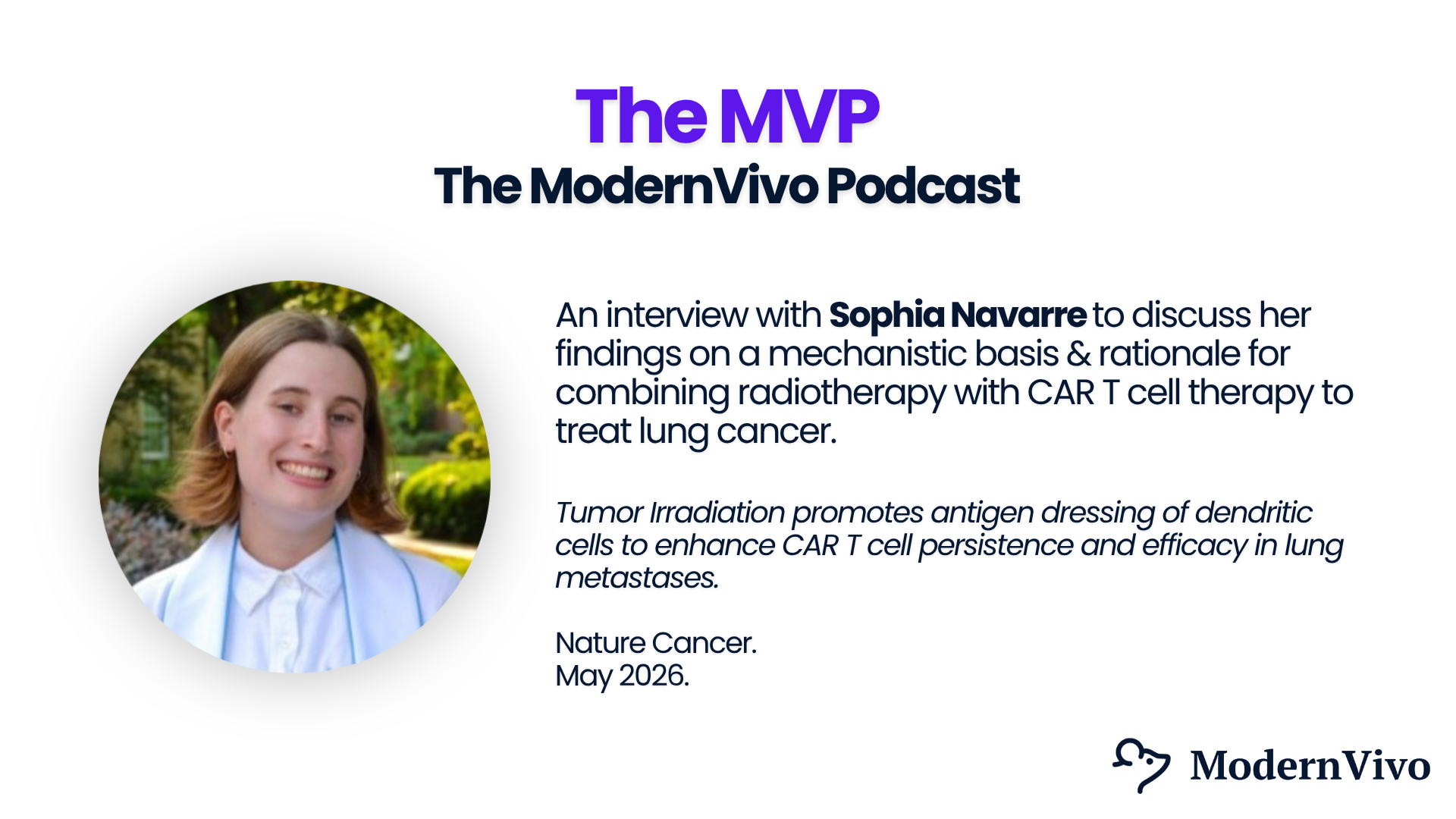
Season 1, Episode 5 Show Notes: Sophia Navarre
An interview with Sophia Navarre about how tumor irradiation reshapes the environment around a tumor so that CAR T cells persist longer and fight cancer more effectively.
In this episode of The MVP, I sat down with Sophia Navarre to discuss research she contributed to in Dr. Jalal Ahmed's lab at the Icahn School of Medicine at Mount Sinai, published in Nature Cancer in May of 2026. The paper is titled "Tumor irradiation promotes antigen dressing of dendritic cells to enhance CAR T cell persistence and efficacy in lung metastases." In this blog post you can read more about the findings and Sophia's career journey. A link to the publication is available here to read. You can connect with Sophia on LinkedIn if you'd like to discuss the work further. Watch or listen on Youtube, Spotify, or Apple Podcasts.
To inquire how to be a guest on the podcast, please contact andres@modernvivo.com.
A quick primer on CAR T cell therapy.
For listeners new to the field, Sophia offered a clear starting point. CAR stands for chimeric antigen receptor. In simple terms, it's something engineered onto a T cell — one of the immune cells whose job is to detect foreign or harmful things in the body — that makes it better at finding cancer. Normal T cells struggle here because cancer has evolved ways to evade them. The idea behind a CAR is to find something specific to the cancer that isn't on healthy tissue, build a receptor that recognizes that antigen, and put it on the T cell so it knows where the cancer is.
This approach has been strikingly successful in certain blood cancers — B cell cancers like leukemia and lymphoma — a breakthrough Sophia described as an exciting proof that deliberately working with the immune system can produce real results. But that success has been much harder to reproduce in other cancers. Her lab focused on lung cancer, one of the tougher ones, where a central problem is that the CAR T cells that reach the tumor don't persist.
A different angle: change the environment, not the cell.
Most efforts to fix the persistence problem have tried to re-engineer the CAR T cell itself. Sophia's lab took a different approach: rather than change the cell, change the environment so the CAR T cell is more likely to survive and keep working. They did this with radiation.
Why do CAR T cells fizzle out? To stay activated inside a tumor, a CAR T cell needs ongoing signals telling it to stay alive and keep doing its job. Often it simply isn't getting them, because the antigens it needs to engage are hidden — the cancer conceals them. The main discovery of the paper is a mechanism pairing CAR T cell therapy with radiation, where the radiation causes the CAR T cells to stick around longer and keep fighting.
A key detail Sophia emphasized: the radiation dose used isn't a tumor-killing treatment dose. It's a low, palliative-level dose. So the improved persistence isn't simply because radiation is killing tumor cells — there's a separate effect, in which the radiation reshapes the tumor's microenvironment. As the paper reports, a single 8 Gy dose of tumor irradiation significantly enhanced CAR T cell persistence, and it did so in a way that depended critically on dendritic cells.
"Antigen dressing" and the role of dendritic cells.
The tumor microenvironment contains far more than cancer cells and CAR T cells. One of the other residents is the dendritic cell, a potent antigen-presenting cell. What the team found is that irradiation enables a productive connection between dendritic cells and CAR T cells — so the value of the paper, as Sophia put it, isn't just that radiation makes things easier for the CAR T cells, but that it changes what the CAR T cells have access to.
The mechanism they named is "antigen dressing." Traditionally, the antigen a CAR T cell needs was thought to sit mainly on the tumor cells themselves. But the team found that irradiation allows dendritic cells to pick up antigen from the tumor cell and present it to the CAR T cell. The CAR T cell doesn't necessarily have to make direct contact with the tumor cell; the dendritic cell acts as an intermediary, yet because the antigen is still tumor-specific, the CAR T cell still goes on to kill the tumor. In the paper's terms, this happens through a rapid, trogocytic transfer of surface antigen onto the dendritic cells — a process that can occur within minutes of cell contact. When functional dendritic cells were absent, irradiation failed to sustain CAR T cell persistence and tumors relapsed.
Sophia stressed how translational this is: both radiation and CAR T cells already exist in the clinic, so the new idea of combining them could, hopefully, start to change lives before long.
The bigger takeaway.
Beyond the specific lung cancer model, Sophia sees a broadly extendable concept: disrupting the environment the tumor has built around itself can give the T cells an advantage — which is a different mindset from only trying to change the cell itself. As she put it, the lesson that's stayed with her is to think about the environment you're placing yourself into, not just the individual actor. It's changed how she reads papers now, always trying to understand the whole system, including people’s personal motivations, rather than only zooming in on data.
On career, mentorship, and persistence.
Sophia's own path runs through this theme. She did her bachelor's in biomedical engineering at UNC Chapel Hill, working in a biomaterials lab on polymer injectables for HIV prevention — an experience that got her interested in both biomaterials and immunology. Unsure whether to pursue a PhD right away, she spent three years in Dr. Jalal Ahmed's lab at Mount Sinai, where she contributed to this publication, before starting her PhD in biomedical engineering in Dr. Steve Nicoll's lab at City College, where she's now focused on hospital-acquired infection — particularly the stubborn problem of prosthetic joint infections and the bacterial and immune interactions behind them.
A few pieces of hard-won advice came through in our conversation:
On skills and confidence, she noted that the ability to run an experiment and trust your results isn't something you either have or don't — it's something you build by trying and continuing, even when a technique takes a while to get the hang of.
On reading science, one of her biggest shifts was learning to approach papers critically — recognizing that there's a lot of room between a result on a graph and the conclusion drawn from it — and to value outside feedback precisely because anyone working on a problem long enough gets entrenched in a particular angle.
On asking for help, she was candid that reaching out to more senior scientists felt awkward and anxiety-inducing at first, when you feel you have nothing to offer in return. What helped was simply needing to get the work done — and realizing that most scientists have been in that same confused, unsure place themselves. Her rule of thumb: if someone says yes to helping you, accept it and don't second-guess whether you should have asked.
On the PhD decision, she's firmly pro–gap year. Her time at Mount Sinai taught her which environments she thrives in — ones where she's trusted as a scientist and given room to explore and design experiments — which in turn helped her choose an advisor deliberately. As many people say, she noted, the advisor really is the most important part of the decision, and she wouldn't have known what she was looking for without that earlier work experience.
If you'd like to discuss the research or Sophia's work further, reach out to her on LinkedIn.
ModernVivo designs best-in-class literature review software to help preclinical scientists identify insights from millions of peer-reviewed papers to design their in vivo studies faster.
Anyone can sign up and start using ModernVivo for free. Whether you're an academic, a biopharma scientist, or a contract research organization, our tool can help you save countless hours on manual literature review, without sacrificing scientific rigor.
To learn more about how ModernVivo works, check out this demo. Reach out to andres@modernvivo.com if you'd like to discuss how we can support your research needs.